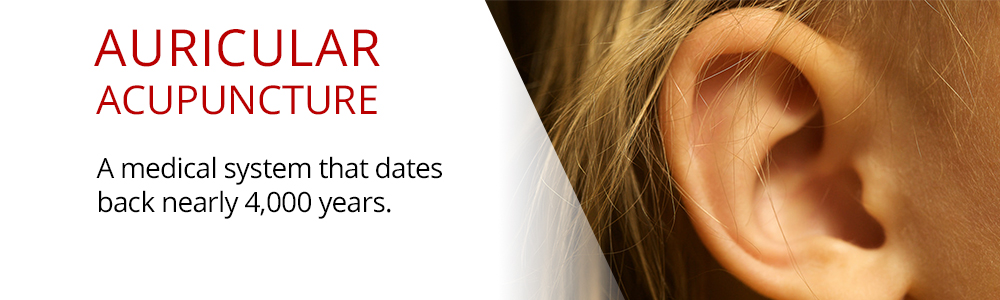
Traditional Chinese Medicine is a medical system that dates back nearly 4,000 years. Auricular acupuncture was first mentioned around 500 B.C. in the Yellow Emperor’s Classic of Internal Medicine, which is the equivalent of the Bible for TCM practitioners. However, the method in which auricular acupuncture is practiced today is actually based upon discoveries that occurred in France in the 1950s. Modern auricular acupuncture is based upon the work done by Dr. Paul Nogier of France.
Auricular acupuncture is the stimulation of the external ear for the diagnosis and treatment of health conditions. These health conditions may be taking place anywhere throughout the body. The stimulation of these acupuncture points can be done manually, with an acupuncture needle, a laser, magnets or ear seeds. Regardless of the means of stimulation, auricular acupuncture can be a very powerful addition to regular acupuncture treatments.
The current form of auricular acupuncture came about after Dr. Nogier noticed a scar on the upper ear of some of his patients. When he inquired about the scar, he found out a local practitioner had been treating his patients for sciatica pain and she was cauterizing this specific area on the external ear to relieve their low back pain. Dr. Nogier conducted similar tests on his own patients and found their low back pain was also relieved. He tried using other means of stimulation as well, such as acupuncture needles and found it to be just as effective as cauterizing the area. So Dr. Nogier theorized if an area of the upper external ear is effective on treating low back pain, then perhaps other areas of the ear could treat other parts of the body. This led to the model now used when teaching auricular acupuncture. The ear is thought to represent the whole anatomical body. However, it is upside down in orientation, so the head is represented by the lower ear lobe, the feet are at the top of the ear and the rest of the body is in between. According to history, the Chinese actually adopted this model of auricular acupuncture in 1958.
Auricular acupuncture is considered a microsystem, in that the ear is like a microcosm of the whole body, meaning one part of the body, the ear in this instance, represents the whole body. Microsystems also appear on foot and hand reflexology, facial acupuncture and scalp acupuncture.
This system has been practiced in Asia, albeit in a different form, for over 2,000 years. Auricular acupuncture has been used in Europe for the past 40 to 50 years. And it is finally starting to take root in the United States. The U.S. military, over the past 5 to 10 years, has started utilizing auricular acupuncture for its battlefield personnel. This form of battlefield acupuncture is used to help soldiers deal with PTSD (post-traumatic stress disorder) brought on by being in combat.
Since auricular acupuncture allows for every part of the external ear to connect through the microsystem to every part of the body, many conditions can be treated using only a few very tiny needles. Not only can PTSD be treated using auricular acupuncture, but also things like chronic pain, drug addiction, high blood pressure and nausea. And for those who are a little needle-shy, auricular acupuncture is a great way to treat them because they will never see the needles and they will still get the help they need to achieving health and wellness.
Photo credit: Ear – Travis Isaacs | CC 2.0



 A study published by the Journal of Sleep Medicine shows acupuncture is a safe and effective treatment for insomnia sufferers. The study group was composed of 72 patients with primary insomnia. Acupuncture treatments were given three times a week for four weeks and the patients were required to wear sleep monitors, as well as complete regular questionnaires. The outcomes were measured by the Insomnia Severity Index, sleep efficiency, sleep awakenings and total sleep time. The Insomnia Severity Index of the patients improved greatly, as did the sleep efficiency and the total sleep time. This study provides evidence that acupuncture can be of great help to insomnia sufferers.