 A recent study published by the Journal of Neural Regeneration Research found acupuncture treatments can lead to improved cognitive function. Functional brain MRIs showed an increase in the communication areas of the brain associated with higher level cognitive function and memory. When cognitive function is improved, so too is one’s ability to stay focused and on task. This study also concluded acupuncture treatments can increase neural plasticity, which decreases naturally as we age. All of this demonstrates acupuncture can indeed improve overall brain function, allowing people to live more fulfilling lives.
Staying focused can be challenging in the world we live in. We are constantly bombarded with sights, sounds, smells, interruptions and more. It can be really frustrating. A recent study by Microsoft found the average human has an attention span of only eight seconds! By comparison, a goldfish has a nine second attention span. We, as a species, can’t even remain focused as long as a goldfish. This speaks volumes about the state of the world.
Part of the problem is our bodies were designed to move and we have become too sedentary. Our nervous system doesn’t know how to respond to this. And it also affects our muscles, tendons and circulatory systems. The more time we spend on our phones, tablets, etc., the more stagnant everything becomes. Our muscles shorten, tighten and atrophy, our circulation becomes sluggish and our brains foggy. For everything to function properly, you have to get up and move. But there are other ways to increase focus and concentration.
Traditional Chinese Medicine (TCM) can be very helpful when it comes to improving focus and concentration. There are specific acupuncture points, as well as individual herbs and herbal formulas that can be utilized.
One of the most commonly used acupuncture points for improving focus is called Du 20 or Governing Vessel 20. This point is located on the top of the head, midway between the apexes of both ears. Du 20 has been noted to improve mental clarity and awareness, while also enhancing memory.
Yin Tang is another favorite point of licensed acupuncturists. Yin Tang is located between the inner ends of both eyebrows. Yin Tang improves concentration and memory, while also clearing the mind and lifting the spirits.
There are a couple of individual herbs used in TCM that can be very helpful for improving focus. The first is known as Dan Shen or Salvia. TCM uses this herb to increase blood flow and a study done in 2003 showed focus and memory were improved on subjects who used this herb.
An herbal formula known as Bu Nao Wan is frequently prescribed for people who have memory problems related to weakness in the kidney system of TCM. Several of the herbs in this formula have been used for centuries to calm the mind and improve focus.
If you or somebody you know suffers from attention deficit issues, acupuncture might be exactly what they need to get back on track. Ask me to find out how acupuncture can help!
CITATION: https://www.ncbi.nlm.nih.gov/pmc/articles/PMC5361509/
 Today the average worker experiences stress levels higher than in previous decades. There are many causes to the increase in stress but there are also many ways to effectively combat these stressors and experience a life with less stress and more happiness. One of the main reasons people feel so stressed out is that with the invention of the Internet, email and, most notably, the smartphone, it often feels like you are attached to work, you can never fully disconnect and be released from your work duties. The pressure to always be connected is hard to let go of, especially when your smartphone is in your hand. One way to combat this is to set guidelines for yourself on when you will and will not answer an email or message. Turn the phone off when you are home and off of work, if that is not possible, schedule when you will check your messages so it can be planned and contained instead of all consuming. When you are not at work, make sure you can keep those boundaries firm and not be drawn to work 24/7.
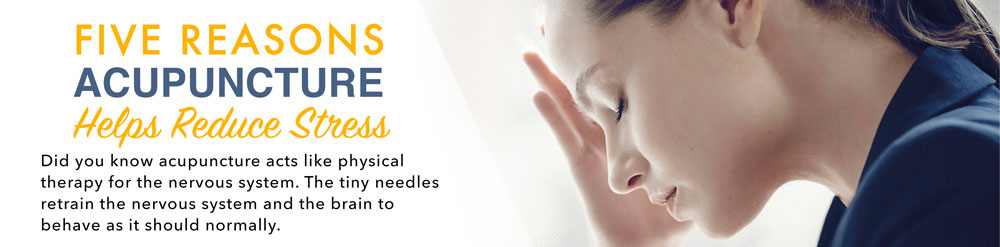 Stress is a word many people are familiar with. The dictionary defines stress in multiple ways, but there is only one that matters when we discuss how stress affects our physical bodies. The definition is this, “stress is a physical, chemical or emotional factor that causes bodily or mental tension.” And while most people think of stress as being detrimental, it truly does have a function in our bodies. Stress is the body’s way of signaling for help or a break in the routine. If we don’t listen to these signals, we can develop imbalances in our bodies, which can then lead to illnesses.
  A study published by the Journal of Traditional Chinese Medicine concludes acupuncture treatments can indeed help treat the common cold. The study followed 187 participants based on the onset of when the cold occurred. The participants were divided into two groups. The first group reported an onset time of cold symptoms within 36 hours and the second group reported an onset of symptoms greater than 36 hours. Both groups showed significant decreases in symptoms, as well as cold duration. This study demonstrates how receiving acupuncture treatments can shorten the length of time a person deals with the common cold and its symptoms.
  Acupuncture is part of a medical system that dates back nearly 3,500 years. This medical system is known as Traditional Chinese Medicine or TCM. TCM acknowledges not four but five seasons. The fifth season, Indian Summer, occurs in late August through mid-September. Each season in TCM has a pair of organs or energetic pathways it corresponds to. For Indian Summer, these pathways are those of the spleen and stomach.